How to Grade Pokémon Cards: A Break-Even Analysis
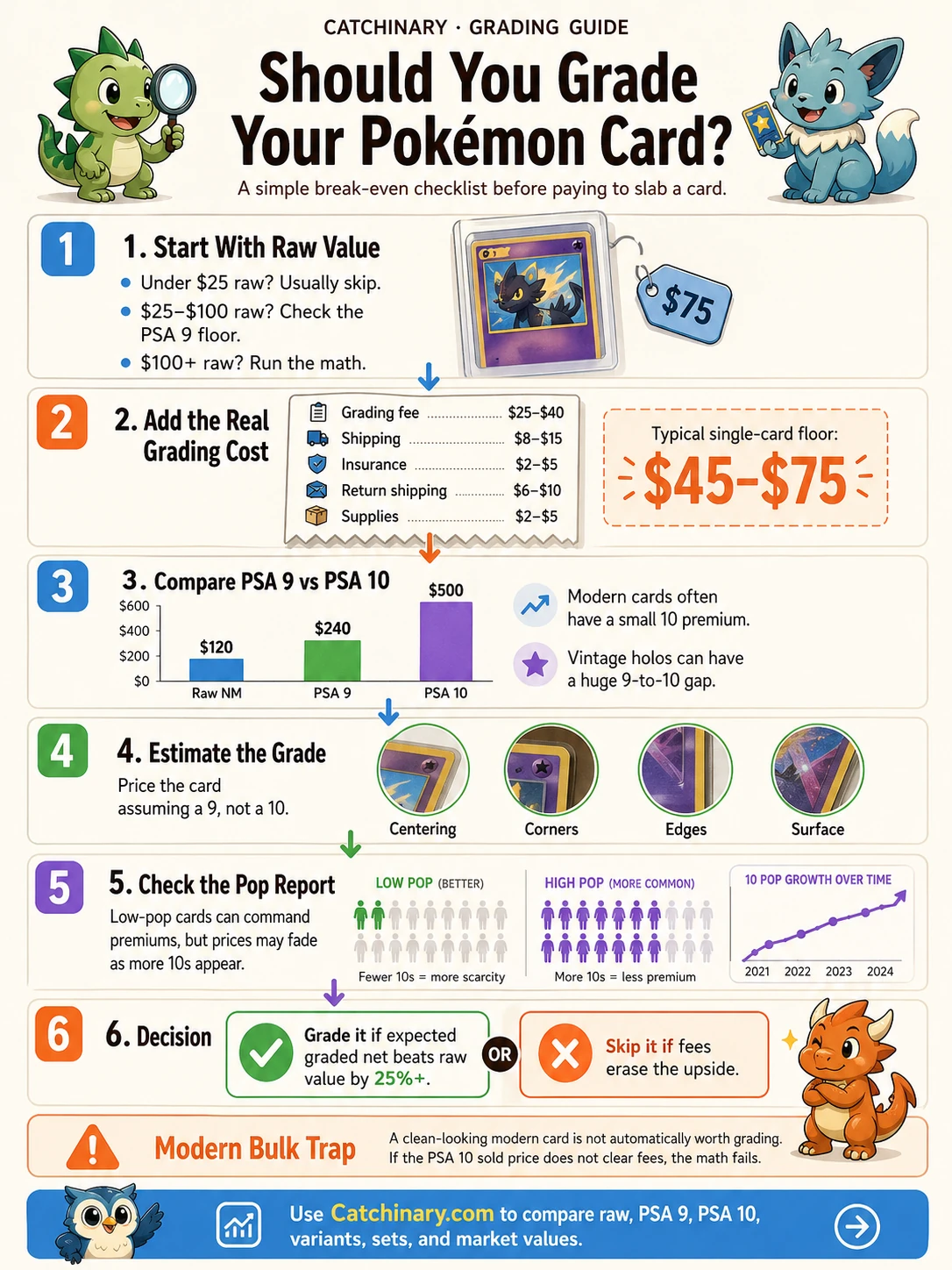
Grading isn't always worth it. The all-in cost of slabbing a single Pokémon card runs $45 to $75 once you add up the fee, shipping there, shipping back, and supplies. Below a certain raw card value, that floor eats the entire upside even on a perfect outcome.
This is a data-driven look at when paying to grade a card actually pays — built on Catchinary's sold-comp database and our proprietary CIV scoring. The short version: it depends on raw price, era, and which service you use. The long version is below.
The break-even formula
The grading economics for any single card reduce to a simple inequality. You break even when the expected graded value, weighted by the probability of each grade outcome, exceeds the raw value plus all submission costs.
In plain English: (P10 × probability of 10) + (P9 × probability of 9) + (P<9 × probability of lower) − fees − shipping − return shipping needs to clear your raw sale price. Below a $25 raw, the fee floor alone usually wins.
| Cost component | Typical amount | Notes |
|---|---|---|
| Grading fee (Value tier) | $25 | Cards declared value <$500 |
| Shipping to grader | $5 to $15 | USPS Priority + insurance |
| Return shipping | $15 to $30 | Scaled with declared value |
| Optional sleeves and cases | $1 to $3 | Card savers + team bag |
| All-in floor | $45 to $75 | Per card, single-card submission |
Bulk submissions cut this dramatically — at 20+ cards, fee per card drops and shipping is amortized. See PSA's current fee tiers and CGC's published rates for the exact numbers as of the current month.
PSA 9 vs PSA 10 premium gaps by era
The single biggest variable in grading economics is how much more a PSA 10 sells for than a PSA 9 of the same card. That gap moves with era, set, and card popularity.
| Era | Avg PSA 9 sold | Avg PSA 10 sold | Premium |
|---|---|---|---|
| WotC Vintage (1999 to 2003) | $185 | $760 | 4.11× |
| EX Series (2003 to 2007) | $48 | $172 | 3.58× |
| Diamond & Pearl / Platinum | $32 | $98 | 3.06× |
| BW / XY / Sun & Moon | $22 | $54 | 2.45× |
| Sword & Shield | $18 | $32 | 1.78× |
| Scarlet & Violet (modern) | $14 | $21 | 1.50× |
Always price the realistic outcome. About half of submissions come back below the submitter's expectation. Math the math against a PSA 9, not a PSA 10, especially on modern submissions.
The modern bulk trap
The most common grading mistake on r/PokemonCardValue and r/PSAGrading is grading clean-looking modern bulk. A $12 raw modern holo with a 1.5× PSA 10 premium nets $18 if it grades a 10 — minus $45 in fees and shipping, you've lost $39.
Skip: any modern card with raw value under $20 and a known PSA 10 sold price under $50. The fee math doesn't recover even on a perfect grade.
Vintage holos: the slam-dunk tier
The other end of the spectrum: a Base Set Charizard in NM raw at ~$400. PSA 9 sells for ~$1,800; PSA 10 for ~$8,500. Even at a 60% probability of getting a 9 and 30% of a 10 (with 10% lower), expected graded value is ~$3,400 — well clear of the $400 raw plus $50 fee. Browse the full Base Set card list for sold comps on every card.
| Card | Raw NM | PSA 9 | PSA 10 | Verdict |
|---|---|---|---|---|
| Base Set Charizard (Unlimited) | $400 | $1,800 | $8,500 | Grade |
| Neo Genesis Lugia | $320 | $1,150 | $5,200 | Grade |
| Skyridge Crystal Charizard | $650 | $2,400 | $11,000 | Grade |
PSA vs CGC vs BGS fees and liquidity
Choosing the grader is a fee-vs-liquidity trade-off. CGC's Value tier is cheaper than PSA's, but PSA-graded cards command a 10 to 25% liquidity premium on most modern slabs. For chase cards, PSA almost always nets more after fees. BGS sits in the middle on fees but commands a premium for the rare "10 black label" pristine designation.
| Company | Entry-tier fee | Turnaround | Liquidity premium | Best for |
|---|---|---|---|---|
| PSA | $25 | ~45 days | Highest | Modern chase, vintage |
| CGC | $18 | ~30 days | Medium | Bulk modern, value tier |
| BGS | $30 | ~60 days | Medium-high | Pristine moderns (10 black label) |
When a 9 actually hurts you
For some cards, getting a 9 is worse than not grading. If raw NM sells for $200 and a PSA 9 sells for $185, a $45 grading fee means you've paid to lose $60. Always check the PSA 9 sold price against your raw NM sold price before submitting.
Pro tip. Use the PSA Population Report to spot cards where the 9 floor is below current raw NM. These are the trickiest "should I grade?" calls.
Step-by-step decision flow
Here's the flow we recommend for any card you're considering grading:
| Step | What to do | Why |
|---|---|---|
| 1. Identify | Set, number, variant. Use Catchinary's card lookup. | Wrong card identification ruins every later step. |
| 2. Pull comps | Raw NM, PSA 9, PSA 10 sold prices (last 30d). eBay completed only. | Active listings lie. Sold prices are truth. |
| 3. Expected value | Apply rough probabilities — 10% PSA 10, 60% PSA 9, 25% PSA 8, 5% lower for NM-rated cards. | Assume the realistic outcome, not the best one. |
| 4. Subtract fees | $45 to $75 single-submission. Less for bulk (20+). | Don't forget return shipping and insurance. |
| 5. Compare to raw NM | If expected graded net > raw NM by 25%+, grade it. Otherwise sell raw. | The 25% buffer covers the half-of-submissions-grade-low risk. |
| 6. Check pop | If pop is <100 PSA 10, premiums may be inflated and likely to compress as supply grows. | First-of-grade premiums fade. |
FAQ
What's the minimum raw card value to consider grading?
For modern cards, around $40 raw NM. Below that, even a PSA 10 outcome doesn't reliably clear the fee floor. For vintage, the floor drops because grade premiums are larger.
Is CGC worth it instead of PSA?
For value-tier bulk, yes — CGC fees are lower and turnaround is faster. For chase cards, PSA's liquidity premium usually wins after fees.
How long does PSA grading take in 2026?
Value tier averages 45 days. Express tiers (Regular, Express, Walkthrough) range from 5 to 20 business days but cost $75 to $300+ per card.
Can a card lose value after grading?
Yes. If the card grades a 9 and the PSA 9 floor is below raw NM, you've paid to lose value. Most common on common-rarity vintage and damaged-modern submissions.
Should I grade Japanese Pokémon cards too?
Japanese exclusives often grade higher than English equivalents because print quality is better. Premiums vary, but Japanese vintage and recent Special Art cards can be slam-dunks.