Reference
How to Spot a Fake Pokémon Card: A Ranked Authentication Checklist
Most "how to spot fake Pokémon cards" guides list eight to ten tests as if each one carries equal weight. They don't. Three checks catch about 80% of fakes in 60 seconds. The other tests catch the remaining 20%, but most of them require a loupe, a microscope, or a UV flashlight you probably don't own. Running them all on a $20 card is a waste of time. Skipping them on a $2,000 card is a way to lose money.
This is the ranked workflow: which tests actually catch fakes, in what order, and when to stop based on what the card is worth.
Key takeaways
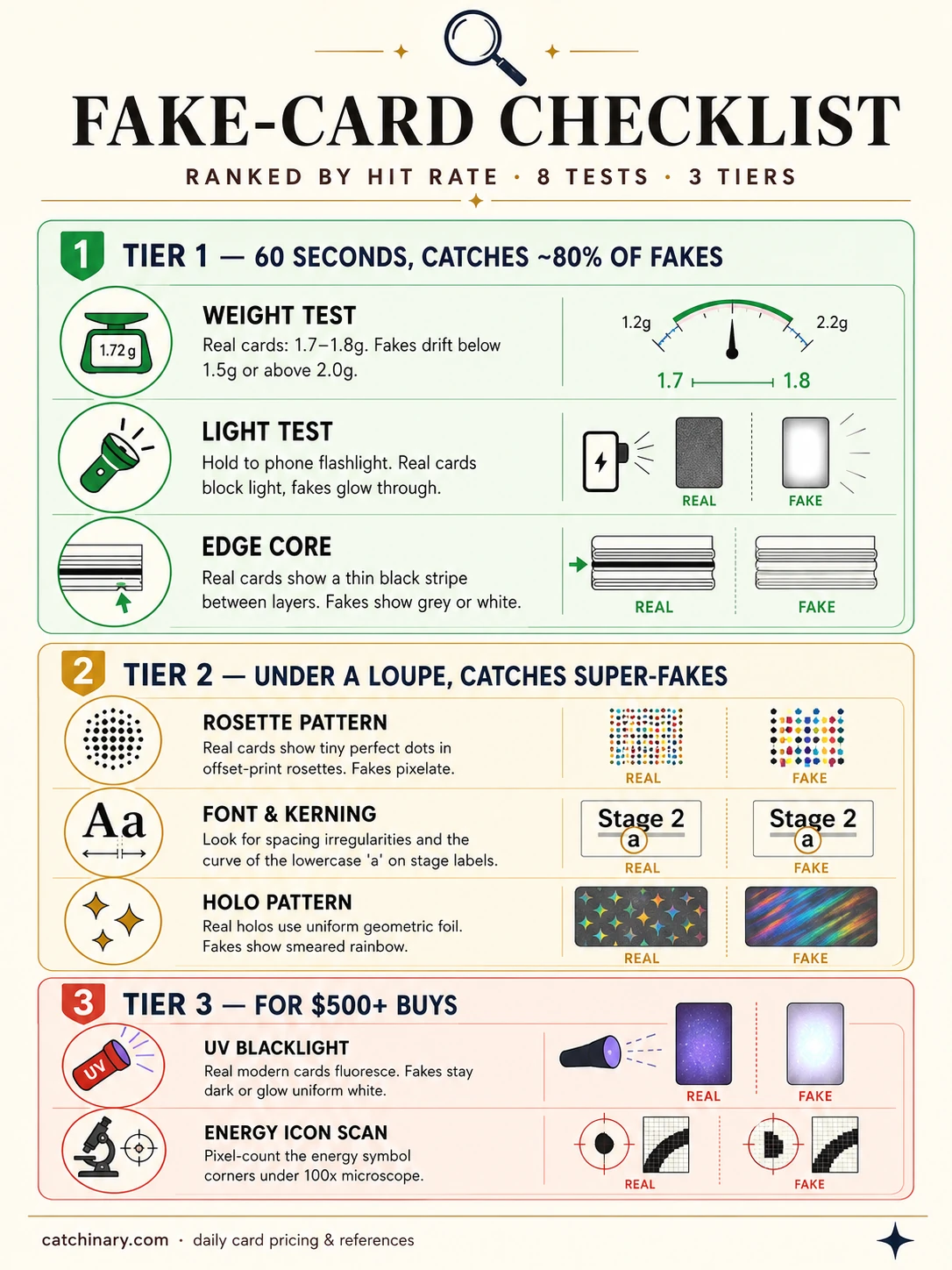
- Three Tier 1 checks catch roughly 80% of fakes in under 60 seconds: weight (real cards 1.7-1.8g), the light test (real cards block light, fakes glow through), and edge core color (real cards show a thin black stripe, fakes show grey or white).
- Tier 2 checks (rosette pattern, font and kerning, holo pattern under a loupe) catch the super-fakes that pass Tier 1.
- Tier 3 checks (UV blacklight, energy-icon micro-inspection) are forensic-level tools, only worth running on cards above $500.
- 2025-2026 "super fakes" use better cardstock that sometimes passes the light test, so the weight + edge inspection now matter more than ever.
- Decision tree: under $50, run Tier 1 only. $50 to $500, add Tier 2. $500+, run all three tiers before paying.
Tier 1: the 60-second checks that catch most fakes
Three tests, no special tools beyond a kitchen scale and a phone flashlight. Run these on every card, every time, before you pay.
1. Weight
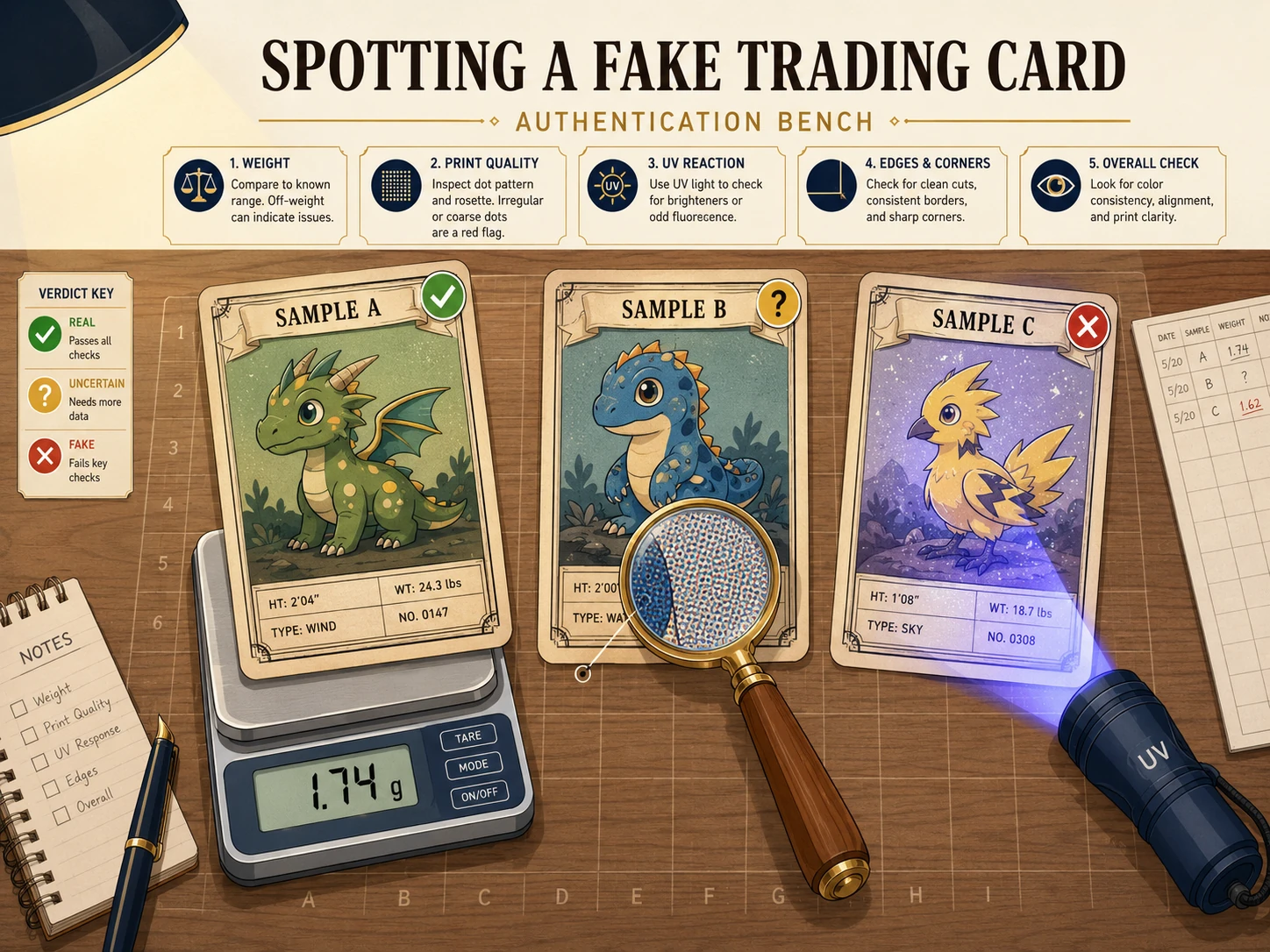
Real Pokémon cards weigh 1.7 to 1.8 grams for standard non-holo cards, and up to about 2.0 grams for holos and textured cards. Fakes typically come in noticeably under 1.5 grams or noticeably over 2.0 grams because counterfeit cardstock can't match the multi-layer construction of the real thing.
A digital scale accurate to 0.01 grams costs about $13 on Amazon. Anyone trading cards above $20 should own one. The reading takes three seconds.
The catch with weight: it's the single easiest fake-attribute to match if a counterfeiter cares enough. So a passing weight reading doesn't mean real. A failing weight reading means almost certainly fake.
2. Light test
Hold the card flat against a phone flashlight in a dark room. Real cards block most of the light because they have a thin black core layer sandwiched between the front and back cardstock. The card will appear opaque or dim from the side opposite the light.
Fakes typically lack the black core. They glow brightly when backlit because light passes straight through the cheap cardstock.
The catch with the light test: 2025-2026 super fakes have started using better cardstock that partially blocks light. They don't pass cleanly, but they sometimes pass casual inspection. If a card looks borderline on the light test, treat it as suspicious and run Tier 2.
3. Edge core
Look at the side edge of the card under good light. A real card shows a clearly visible thin black horizontal stripe running through the middle, sandwiched between two cream/white cardstock layers. This is the black core that does the light blocking.
Fakes show one of two things: a uniform white or grey edge with no stripe, or a stripe that's the wrong color (often dark grey rather than true black). Both fail.
This check takes longer than weight or light because it requires good close-up vision or a basic magnifier, but it's nearly impossible to fake at scale. The black core is structurally different cardstock, and counterfeiters who get the weight and light right almost never get this one right too.

Tier 2: under-a-loupe checks for super-fakes
If a card passed Tier 1 and the price is over $50, run these. A 30x jeweler's loupe costs about $10. A digital USB microscope is better and runs $30-60.
4. Rosette pattern
Real cards are printed on commercial offset presses, which produce tiny, perfectly round dots arranged in consistent rosette patterns. Under 30x magnification you'll see a precise dotted lattice that looks like a halftone print pattern.
Fakes printed on inkjet or low-end digital presses show pixelation, irregular dot sizes, or solid color blocks where there should be dots. The rosette test catches super fakes that nail weight, light, and edge core but can't replicate offset printing.
5. Font and kerning
Look at the lowercase letters on attack names and stage labels. Real cards have professional kerning (consistent letter spacing) and use the official Pokémon TCG fonts with their specific quirks: the lowercase 'a' has a particular curve, the 'g' has a closed loop, the spacing between letters in "Stage 1" is consistent.
Fakes get the font close but not exact. Common fails: the 'a' is wrong shape, the spacing is uneven, the energy-cost text has incorrect baseline alignment. Compare side-by-side with a known-real card from the same era for the cleanest read.
6. Holo pattern
If the card is a holo or reverse holo, examine the foil under angled light or magnification. Real holo patterns use uniform geometric foil structures (cosmos pattern, crosshatch pattern, etc.) that are consistent across the entire holographic area.
Fakes typically show smeared, swirly, or rainbow-streaked foil that doesn't match a known real-card pattern. Modern alt-art textured cards have specific raised-texture grids; counterfeit textured cards are usually flat or have generic embossed patterns.
Tier 3: forensic checks for $500+ cards
These take real time and real tools. Worth it for high-value cards, overkill for everything else.
7. UV blacklight
Real modern Pokémon cards (post-2003 era roughly) fluoresce under UV light because of optical brighteners in the cardstock. The reaction is subtle but visible: the card glows a faint pale blue-white when exposed to a 365nm UV flashlight in a dark room.
Fakes either stay dark (cheap cardstock with no brighteners) or glow uniformly bright white (over-brightened fake stock). Neither matches the real reaction. UV testing is era-specific: vintage cards (Base through Neo Destiny) react differently or barely react, so know what era you're testing before drawing conclusions.
8. Energy icon micro-inspection
Under a 100x microscope, examine the energy symbols on the attack costs. Real symbols have clean, sharp pixel boundaries and consistent corner alignment because they're vector-printed at high resolution.
Fakes show fuzzy edges, missing corner pixels, or aliasing artifacts because they're scanned-and-reprinted at lower DPI. This is a forensic-level check that's almost always conclusive but requires patient inspection.
Decision tree by card value
The whole point of this ranking is to stop running every test on every card. Match the workflow to the stakes.
- Under $50. Tier 1 only (weight + light + edge core). Three checks, 60 seconds. If anything fails, walk away. If everything passes, the card is almost certainly real.
- $50 to $500. Tier 1 + Tier 2 (loupe inspection: rosette + font + holo pattern). About 5 minutes. Catches super fakes that pass casual inspection.
- $500+. All three tiers including UV blacklight and microscope-level energy-icon inspection. About 15 minutes. At this price point the cost of authentication is trivial relative to the cost of a mistake.
- Anything over $1,000. Buy graded only, or run all three tiers AND verify against a known-authentic comparison card from the same set. Counterfeiters have figured out high-value vintage and modern alt arts; raw at this tier is buyer-beware.
Why this matters more in 2026
Counterfeit quality has stepped up. The "super fake" generation that started showing up in late 2024 uses better cardstock that sometimes passes the light test, more accurate fonts that pass casual eye check, and improved holo patterns that look right at first glance.
What still catches them, consistently:
- Weight measurement — fakes still struggle to hit 1.7g exactly, often coming in at 1.5g or 2.0g+
- Edge core inspection — the black stripe is structurally different from anything counterfeiters can produce cheaply
- Rosette pattern under loupe — offset printing is expensive, and counterfeit operations rarely invest
The Tier 1 + Tier 2 combination catches roughly 95% of even the new generation of super fakes. The remaining 5% require Tier 3 forensic inspection.
FAQ
Is a digital scale really necessary?
For anything over $20, yes. The scale is the single fastest, cheapest, most reliable test. It rules out the majority of cheap fakes in three seconds. The $13 cost pays for itself the first time it stops a bad purchase.
What about authenticator services like CGC, PSA, or Beckett?
Grading services authenticate as part of grading. If a card comes back graded, it's been through their authentication process. For raw cards above $500, sending in for grading (and paying the $20-50 fee) is often cheaper than the risk of buying a fake.
Are vintage Pokémon cards (Base, Jungle, Fossil) faked too?
Yes, especially the high-value cards (1st Edition Charizard, Shadowless Holos, Trophy cards). Vintage fakes use the same construction shortcuts as modern fakes: lighter cardstock, no proper black core, off-color edges. The 1.7g weight and edge core test work identically on vintage cards.
What's the single best test if I can only do one?
The light test against a phone flashlight, run with the card flat against the lens in a dark room. It takes 5 seconds, requires no tools, and catches the majority of low-effort fakes. Weight is a close second but requires a scale.
Where can I see live prices to know what's worth authenticating?
Catchinary tracks every English Pokémon card with daily TCGplayer market prices, sold-comp data, and CIV scores. Knowing a card's value tells you which tier of authentication to run before you pay.